
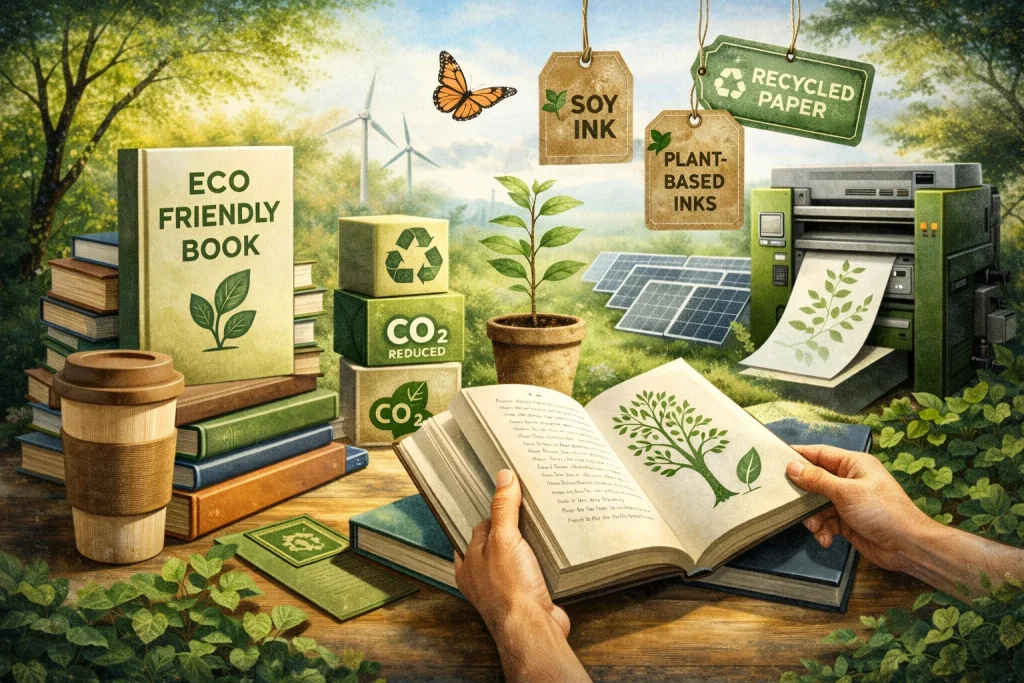
Sustainable book printing combines FSC-certified papers from responsibly managed forests, soy-based or vegetable-based inks that reduce petroleum use and improve recyclability, aqueous coatings that eliminate toxic solvents, and efficient manufacturing processes that minimize waste. Authors seeking genuinely eco-friendly printing must look beyond vague “green” marketing claims to evaluate specific certifications, material choices, and production practices that create measurable environmental benefits.
The challenge for environmentally conscious authors is separating genuine sustainability from greenwashing. Many printers advertise “eco-friendly” options without substantive backing, while others offer real environmental benefits but don’t effectively communicate them. Meanwhile, authors face difficult tradeoffs: Does domestic printing’s reduced shipping footprint outweigh potential material cost premiums? Are recycled papers suitable for full-color children’s books? Will sustainable choices compromise the quality readers expect?
This guide cuts through the confusion, explaining exactly what sustainable book printing means, which options deliver real environmental benefits, and how to make informed choices that align your book production with your values. With over 30 years of combined experience serving environmentally conscious authors nationwide, the PRC Book Printing team helps navigate these decisions with honesty about what’s possible and what matters most.
What You’ll Learn
- What Does “Sustainable Book Printing” Actually Mean?
- Why Sustainable Printing Decisions Are So Confusing
- The Key Components of Eco-Friendly Book Production
- Sustainable Options for Every Part of Your Book
- Making Smart Environmental Tradeoffs
- Expert Tips from PRC Book Printing
- Frequently Asked Questions
- Next Steps: Print Your Book Sustainably
What Does “Sustainable Book Printing” Actually Mean?
Sustainable book printing minimizes environmental impact across the entire production lifecycle—from raw material sourcing through manufacturing, delivery, use, and eventual disposal or recycling. It’s not a single choice but a collection of decisions, each affecting different aspects of environmental footprint.
Sustainable book printing addresses:
- Forest stewardship: Where paper pulp originates and whether forests are responsibly managed
- Material composition: Recycled content, virgin fiber sources, and chemical treatments
- Ink chemistry: Petroleum-based versus vegetable-based inks and their environmental profiles
- Coating and finishing: Solvent-based versus water-based options and their emissions
- Manufacturing efficiency: Energy use, waste generation, and pollution controls
- Transportation: Shipping distances, methods, and associated carbon emissions
- End-of-life: Recyclability and biodegradability of finished books
Sustainable printing is NOT:
- A single certification that covers everything
- Always more expensive than conventional printing
- Incompatible with professional quality
- Limited to specific book types or formats
- A marketing term without substance (though some use it that way)
The most sustainable book printing combines multiple responsible choices across these categories, with authors selecting priorities based on which environmental impacts matter most to them and their readers.
Why Sustainable Printing Decisions Are So Confusing
Authors genuinely committed to environmental responsibility often struggle to make informed decisions. Understanding why helps you navigate toward clarity.
Cause #1: Greenwashing and Vague Claims
The printing industry, like many others, contains companies using environmental language without environmental substance. Terms like “eco-friendly,” “green,” and “sustainable” have no regulated definitions. Any printer can claim them without meeting specific standards.
Authors encounter websites featuring leaf imagery and nature language while offering no verifiable certifications or specific sustainable practices. Distinguishing genuine commitment from marketing opportunism requires asking specific questions most authors don’t know to ask.
Cause #2: Complexity of Environmental Tradeoffs
Environmental decisions rarely offer simple “better” and “worse” options. Consider:
- Recycled paper reduces virgin forest demand but may require more processing energy and chemicals to achieve comparable quality
- Domestic printing reduces shipping emissions but may use more energy-intensive manufacturing processes than some offshore facilities
- Lighter paper stocks reduce material use and shipping weight but may compromise durability and reading experience
- Digital printing eliminates plate chemicals and reduces waste for small runs but uses toner with its own environmental profile
Every choice involves tradeoffs. Authors without deep knowledge of printing processes struggle to evaluate which tradeoffs align with their priorities.
Cause #3: Lack of Standardized Metrics
Unlike energy efficiency ratings for appliances or fuel economy numbers for vehicles, book printing lacks standardized environmental metrics. There’s no “sustainability score” letting authors compare printers objectively. Each certification addresses different concerns—FSC covers forest management, soy ink certifications address ink chemistry, and neither tells you about a printer’s energy efficiency or waste management.
Cause #4: Cost Concerns and Misconceptions
Authors often assume sustainable options carry significant price premiums, leading them to avoid even investigating possibilities. In reality, many sustainable choices add minimal or no cost:
- FSC-certified papers are widely available at comparable prices to non-certified options
- Soy-based inks are standard at many professional printers, including PRC Book Printing
- Efficient manufacturing reduces both environmental impact and costs
Cost concerns based on assumptions rather than quotes prevent authors from discovering accessible sustainable options.
Cause #5: Information Overload
Authors researching sustainable printing encounter overwhelming detail—forest certification schemes, ink chemistry specifications, carbon offset programs, recycled content percentages, and manufacturing certifications. Without context for evaluating this information, analysis paralysis sets in. Many authors default to whatever their printer offers rather than making active choices.
The Key Components of Eco-Friendly Book Production
Understanding each component helps you prioritize what matters most for your project.
Paper: The Largest Environmental Factor
Paper accounts for the majority of a book’s environmental footprint. Key considerations:
FSC Certification (Forest Stewardship Council): The gold standard for responsible forest management. FSC certification ensures paper comes from forests managed to preserve biodiversity, protect indigenous rights, and maintain long-term forest health. FSC-certified papers are widely available for book printing.
Recycled Content: Post-consumer recycled content reduces virgin fiber demand. Papers range from 10% to 100% recycled content. Higher recycled content has greater environmental benefit but may affect print quality for some applications, particularly full-color work.
Chlorine-Free Processing: Traditional paper bleaching uses chlorine, producing toxic byproducts. Processed Chlorine Free (PCF) and Totally Chlorine Free (TCF) papers eliminate these concerns.
Acid-Free Paper: While primarily about longevity (acid-free paper doesn’t yellow or become brittle), acid-free processing also eliminates certain chemical treatments, aligning durability with sustainability.
Inks: Moving Beyond Petroleum
Traditional printing inks use petroleum-based solvents that release volatile organic compounds (VOCs) during printing and can complicate paper recycling.
Soy-Based Inks: Derived from soybeans, a renewable resource. Soy inks release fewer VOCs, produce brighter colors requiring less ink coverage, and make paper easier to recycle because they release more readily during de-inking processes. PRC Book Printing uses soy-based inks as standard practice.
Vegetable-Based Inks: Broader category including soy, linseed, canola, and other plant-derived oils. Similar benefits to soy inks with varying performance characteristics.
Low-VOC Inks: Formulated to minimize volatile organic compound emissions regardless of base material. Important for indoor air quality and worker health.
Coatings and Finishes
Coatings protect covers and enhance appearance but vary significantly in environmental profile.
Aqueous Coatings: Water-based coatings that provide protection and finish without solvent emissions. PRC Book Printing uses aqueous coatings, particularly for children’s books where they provide both environmental and safety benefits.
UV Coatings: Cured with ultraviolet light rather than heat, reducing energy use. However, UV-coated papers are more difficult to recycle.
Lamination: Plastic film lamination complicates recyclability. Newer biodegradable and compostable lamination options exist but aren’t universally available.
Uncoated Options: For appropriate applications, eliminating coating entirely reduces environmental impact while creating an organic, tactile aesthetic.
Manufacturing Practices
Beyond materials, how books are manufactured matters:
Energy Efficiency: Modern presses consume less energy per impression. Facilities powered by renewable energy reduce carbon footprint regardless of materials used.
Waste Reduction: Efficient makeready processes minimize paper waste. Recycling programs capture trim waste, misprints, and damaged sheets.
Pollution Controls: Air filtration, wastewater treatment, and chemical management protect local environments around printing facilities.
Transportation and Logistics
Getting books from printer to destination creates emissions:
Domestic Manufacturing: Printing in the United States eliminates transoceanic shipping, reducing transportation emissions significantly compared to offshore production.
Consolidated Shipping: Larger orders shipped together have lower per-book transportation footprints than multiple small shipments.
Ground vs. Air: Ground shipping produces far fewer emissions than air freight, though it requires longer lead times.
Sustainable Options for Every Part of Your Book
Here’s how to make environmentally responsible choices for each book component.
Paper Selection
For Text-Heavy Books (Novels, Memoirs, Non-Fiction):
- FSC-certified uncoated paper with 10-30% post-consumer recycled content
- Acid-free for longevity and chemical reduction
- Natural or cream tones require less processing than bright white
For Full-Color Books (Children’s Books, Cookbooks, Photography):
- FSC-certified coated papers for color accuracy
- Lower recycled content percentages maintain print quality
- Matte finishes often use fewer chemicals than high-gloss
For Maximum Sustainability:
- 100% post-consumer recycled, FSC-certified, processed chlorine-free
- Accept potential quality tradeoffs for environmental priority
- Best suited for text-only or minimal-illustration content
Cover Options
Sustainable Cover Choices:
- FSC-certified cover stock
- Soy-based ink printing (standard at PRC Book Printing)
- Aqueous coating instead of solvent-based alternatives
- Soft-touch lamination with recyclable films where available
Premium Sustainable Options:
- Cloth covers from responsibly sourced textiles
- Recycled chipboard for case covers
- Uncoated covers with protective aqueous finish
Binding Considerations
Most Sustainable Binding Methods:
- Perfect binding with PUR adhesive (strong and recyclable)
- Smyth sewn binding (thread rather than adhesive-heavy methods)
- Saddle stitch for thinner publications (minimal materials)
Avoid When Possible:
- Plastic spiral or comb binding (not recyclable with paper)
- Excessive adhesive use in binding
Finishing Choices
Eco-Friendly Finishing:
- Aqueous coatings provide protection without solvents
- Embossing and debossing add interest without additional materials
- Foil stamping (minimal material use for significant visual impact)
Consider Carefully:
- Plastic lamination (complicates recycling)
- Spot UV (cured coatings affect recyclability)
- Shrink wrapping (plastic waste)
Making Smart Environmental Tradeoffs
Perfect sustainability doesn’t exist. Every choice involves balancing environmental benefits against quality, cost, and practicality. Here’s how to think through common tradeoffs.
Domestic vs. Offshore Printing
Environmental Considerations:
Domestic printing eliminates transoceanic shipping—container ships are significant pollution sources. A book printed in the United States and shipped within the continental US travels hundreds of miles. A book printed offshore travels thousands of miles by ocean freight plus ground transportation.
However, shipping represents a relatively small percentage of a book’s total environmental footprint compared to paper production. A book printed offshore on FSC-certified paper may have a lower overall impact than a book printed domestically on non-certified paper.
PRC Book Printing Offers Both Options:
- Domestic printing (2-5 weeks) for reduced transportation footprint
- Offshore printing (9-13 weeks) for cost-effective full-color production
- Both using responsible material choices
Recycled Content vs. Print Quality
The Tradeoff:
Higher recycled content reduces virgin fiber demand but can affect print quality, particularly for full-color work. Recycled fibers are shorter and less uniform than virgin fibers, potentially affecting opacity, brightness, and ink absorption.
Smart Approach:
- Use high recycled content (50-100%) for text-heavy books where color reproduction is less critical
- Use lower recycled content (10-30%) for full-color books where quality is paramount
- Prioritize FSC certification when recycled content must be limited
Quality and Durability vs. Minimal Materials
The Tradeoff:
Lighter papers and minimal finishing reduce material use but may compromise durability. A book that falls apart quickly has a worse environmental outcome than a well-made book that lasts decades and gets passed between readers.
Smart Approach:
- Build books to last—durability is sustainable
- Use appropriate materials for intended use
- Avoid overbuilding (excessive paper weight, unnecessary finishes) where simpler options suffice
Cost vs. Environmental Premium
The Reality:
Many sustainable choices add minimal cost:
- FSC-certified papers: typically no premium or minimal premium
- Soy-based inks: standard at quality printers like PRC Book Printing
- Aqueous coatings: comparable to alternatives
Some choices add meaningful cost:
- 100% post-consumer recycled specialty papers
- Certified carbon-neutral production
- Biodegradable lamination alternatives
Smart Approach:
- Start with no-cost sustainability improvements (FSC paper, soy inks)
- Add premium options where budgets allow and values prioritize
- Focus resources on highest-impact choices (paper selection)
Expert Tips from PRC Book Printing
Our team helps environmentally conscious authors make practical, impactful choices.
Focus on Paper First
Paper accounts for the largest portion of your book’s environmental footprint. FSC certification for your paper stock delivers more environmental benefit than almost any other single choice. Start there, then address other factors as priorities and budgets allow.
Ask Specific Questions
Vague environmental claims mean little. Ask printers:
- “Is your paper FSC-certified, and can you provide chain-of-custody documentation?”
- “Do you use soy-based or vegetable-based inks?”
- “What coatings do you offer, and are water-based options available?”
- “What happens to your trim waste and misprints?”
Printers committed to sustainability welcome these questions. Those who deflect may not have substantive answers.
Consider Your Whole Print Run Lifecycle
A book’s environmental story continues after printing. Will unsold copies end up in landfills? Books printed in appropriate quantities that sell through have better environmental outcomes than overprinted books that get pulped. Accurate quantity planning is sustainable planning.
Communicate Your Values to Readers
If sustainability matters to your book’s audience, communicate your choices. A simple colophon noting FSC-certified paper and soy-based inks signals your commitment. Readers who share your values appreciate knowing their purchase aligns with their principles.
Don’t Let Perfect Be the Enemy of Good
Pursuing perfect sustainability often leads to paralysis. Making several good choices beats making none while searching for ideal options. Start with accessible improvements and build from there across future print runs.
Frequently Asked Questions
What does FSC-certified paper mean?
FSC (Forest Stewardship Council) certification ensures paper comes from forests managed according to strict environmental and social standards. FSC-certified forests maintain biodiversity, protect water resources, respect indigenous rights, and operate under long-term sustainable management plans. Chain-of-custody certification tracks paper from forest to printed book.
Are soy-based inks actually better for the environment?
Yes, meaningfully so. Soy inks are derived from renewable soybeans rather than petroleum, release fewer volatile organic compounds (VOCs) during printing, produce brighter colors requiring less ink, and release more easily during paper recycling processes. PRC Book Printing uses soy-based inks as standard practice.
Does sustainable printing cost more?
Some sustainable options add cost, but many don’t. FSC-certified papers are widely available at prices comparable to non-certified options. Soy-based inks are standard at quality printers. Aqueous coatings are competitively priced. Premium options like 100% post-consumer recycled specialty papers or carbon-neutral production may add cost, but basic sustainability improvements are often cost-neutral.
Is recycled paper suitable for all book types?
Recycled paper works excellently for text-heavy books like novels, memoirs, and most non-fiction. For full-color books like children’s books, cookbooks, and photography books, lower recycled content percentages (10-30%) maintain the print quality readers expect. Very high recycled content can affect opacity and color reproduction in demanding applications.
How does domestic vs. offshore printing affect environmental impact?
Domestic printing eliminates transoceanic shipping, significantly reducing transportation emissions. However, paper production contributes more to total environmental footprint than shipping. A book printed offshore on FSC-certified paper may have comparable or better overall impact than a book printed domestically on non-certified paper. PRC Book Printing offers both domestic and offshore options using responsible materials.
What makes a coating “eco-friendly”?
Water-based (aqueous) coatings avoid solvent emissions and don’t complicate paper recycling. UV coatings use less energy for curing but can affect recyclability. Plastic lamination protects effectively but makes paper recycling difficult. For environmental priority, aqueous coatings offer the best balance of protection and sustainability.
Can I print a carbon-neutral book?
Some printers offer carbon-neutral programs through verified offset purchases. This adds cost but addresses emissions that sustainable materials alone don’t eliminate. If carbon neutrality is a priority, ask potential printers about offset programs and verification standards.
How do I verify a printer’s sustainability claims?
Ask for specific certifications (FSC chain-of-custody number, for example), request documentation, and ask detailed questions about practices. Printers with genuine commitments provide clear answers and documentation. Vague responses or deflection suggest marketing without substance.
Does book durability affect sustainability?
Absolutely. A well-made book that lasts decades and gets shared among readers has better environmental outcomes than a cheaply made book that falls apart and gets discarded after one read. Quality construction is sustainable construction.
What about e-books versus print—which is more sustainable?
The comparison is complex. E-books eliminate paper but require devices with significant manufacturing footprints and energy consumption. Studies show printed books have lower environmental impact when read multiple times or shared, while e-books have advantages when a single reader consumes many titles digitally. Sustainably printed physical books compare favorably when produced and used responsibly.
How should I communicate my sustainable printing choices to readers?
Include a brief colophon on your copyright page noting key choices: “Printed on FSC-certified paper using soy-based inks” communicates commitment concisely. For audiences particularly concerned with sustainability, more detailed explanations in author’s notes or back matter may resonate.
Can children’s books be printed sustainably?
Yes. PRC Book Printing’s children’s book printing uses soy-based inks and aqueous coatings that provide both environmental benefits and safety compliance for products children handle and mouth. FSC-certified papers are available for children’s books in all formats including board books.
Next Steps: Print Your Book Sustainably
Your book can reflect your environmental values without compromising quality or breaking your budget. The key is making informed choices and working with a printer who shares your commitment.
Key Takeaways:
- FSC-certified paper is the highest-impact sustainable choice—start there
- Soy-based inks and aqueous coatings are standard at quality printers like PRC Book Printing
- Many sustainable options add minimal or no cost
- Domestic printing reduces transportation emissions compared to offshore
- Durability is sustainability—well-made books have better environmental outcomes
Ready to Print Sustainably?
Contact PRC Book Printing for a free, no-obligation quote that incorporates your environmental priorities. Our team will discuss FSC-certified paper options, explain our use of soy-based inks and aqueous coatings, and help you make choices that align your book production with your values.
Phone: (888) 659-8320 Email: info@prcbookprinting.com Hours: Monday–Friday, 9:00 AM – 5:00 PM EST
PRC Book Printing serves environmentally conscious authors nationwide with professional offset printing on Heidelberg presses, delivering quality and sustainability together. Our soy-based inks and aqueous coatings are standard practice, and FSC-certified papers are available for all book types. Free shipping to all continental US addresses is included in every quote.
Print your book in a way you can feel good about—for your readers, your values, and the planet.
Written by the PRC Book Printing expert team, professional book manufacturers with over 30 years of combined experience in the printing and publishing industry. Based in Hatboro, Pennsylvania, our team operates industry-leading Heidelberg offset presses and has helped thousands of authors, publishers, and businesses nationwide create exceptional printed books—from hardcover novels to children’s board books, cookbooks to coffee table books.