
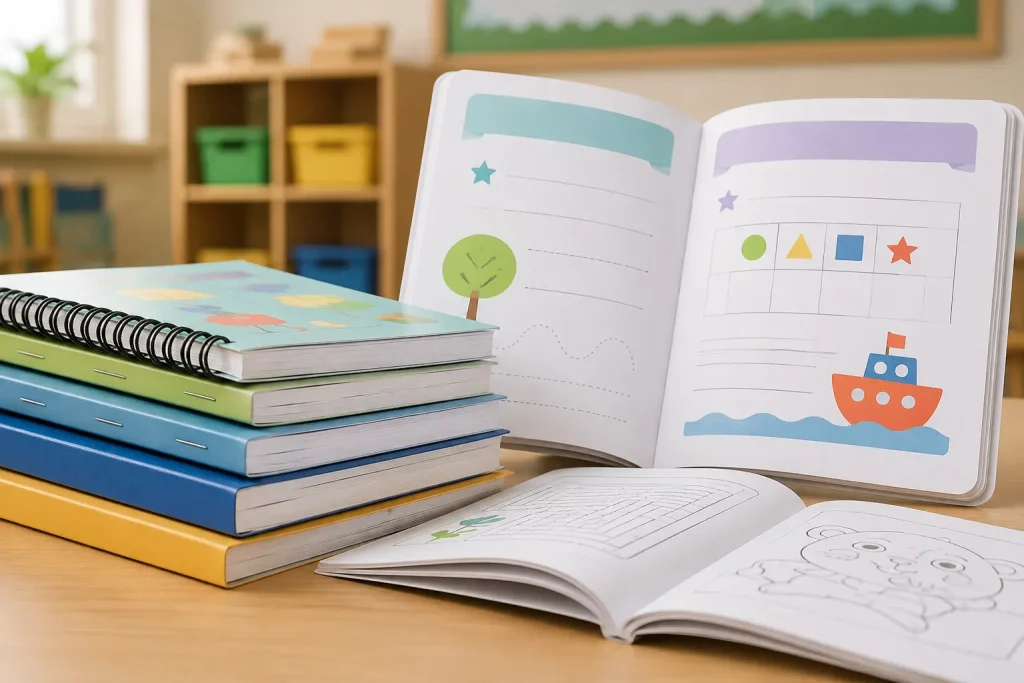
Educational workbook printing requires binding and design choices built for daily student handling, and the right decisions come down to how the book lies flat, how the spine holds up to repeated openings, and how the paper survives erasers, highlighters, and backpacks. For teachers, curriculum publishers, and homeschool creators, a workbook that falls apart mid-semester isn’t just an inconvenience—it undermines the learning tool itself. At PRC Book Printing, our team has spent 30+ years of combined experience in the printing and publishing industry helping educators and publishers produce durable, professional workbooks on industry-leading Heidelberg offset presses. Below, we’ll walk through why classroom workbooks fail, what binding and design factors actually drive durability, and how to choose the right specifications for your project.
What You’ll Learn
- What Is Classroom Workbook Durability and Why Does It Matter?
- The Real Causes Behind Workbook Wear and Failure
- How to Identify Durability Weak Points in Your Workbook Project
- Binding and Design Solutions for Educational Workbooks
- Why Educators and Publishers Nationwide Choose PRC Book Printing
- Frequently Asked Questions
- Next Steps
What Is Classroom Workbook Durability?
Classroom workbook durability refers to how well a printed activity or workbook holds up under the specific stresses of educational use. Unlike a novel that’s read once and shelved, a workbook is opened dozens of times, written in, folded back, carried between home and school, and sometimes shared across multiple students or academic terms.
Common signs a workbook wasn’t built for the classroom include:
- Pages loosening or falling out of the binding after repeated use
- Spines that crack or won’t stay open flat on a desk
- Paper that tears when erased or bleeds through when written on
- Covers that curl, soften, or delaminate over a semester
- Bindings that pop when a student folds the book fully open
This matters most for K-12 workbooks, activity books, homeschool curricula, test-prep guides, and supplemental practice materials—anywhere a student physically interacts with the page rather than just reading it. Ignoring durability means reprinting sooner, fielding complaints, and delivering a product that looks less professional than it should.
The Real Causes Behind Workbook Wear and Failure
Understanding why workbooks fail helps you specify the right printing from the start. In our experience producing educational titles for schools and publishers, most durability problems trace back to a few root causes.
Binding Chosen for Cost, Not Use Case
The single most common cause of workbook failure is a binding method mismatched to how the book is used. Standard perfect binding with weak adhesive can crack when a student forces the book flat to write. Saddle-stitch (staples) works only for very thin booklets and loosens with heavy handling. When the binding isn’t matched to the workbook’s page count and lay-flat needs, pages loosen and spines fail—no matter how good the printing looks.
Paper Weight and Finish That Can’t Handle Writing
Workbooks get written in, so paper choice is functional, not cosmetic. Stock that’s too light bleeds through when students use markers or gel pens, and glossy coatings resist pencil and can’t be erased cleanly. Many workbooks fail here because they were spec’d like a standard trade book rather than an interactive one.
Cover Stock Too Thin for Repeated Handling
A workbook cover takes far more abuse than a novel cover—shoved in backpacks, bent open daily, exposed to moisture. Thin, uncoated, or under-laminated covers curl and soften quickly. What most creators don’t realize is that cover durability depends as much on lamination and stock weight as on the artwork.
Print Technology That Sacrifices Consistency
Print-on-demand and low-end digital printing produce copy-to-copy variation and thinner material options. For a classroom set where every student should have an identical, sturdy book, that inconsistency becomes a visible quality problem. Offset printing on precision presses delivers the uniformity and material range that educational runs require.
How to Identify Durability Weak Points in Your Workbook Project
Before you print, run through this quick self-assessment to catch problems early:
- Test the open-flat requirement. Will students need to write while the book lies flat on a desk? If yes, perfect binding alone may not be enough—consider wire-O, spiral, or Smyth sewn options.
- Check your page count against your binding. Very thin books can saddle-stitch; thicker workbooks need perfect binding or mechanical binding to hold securely.
- Evaluate the writing surface. Grab a proof or sample and test with the pens, pencils, and markers students will actually use. Look for bleed-through and erasability.
- Inspect the cover under stress. Bend a sample cover fully open several times. Watch for curling, cracking, or lamination lifting at the edges.
- Confirm consistency needs. If you’re printing a classroom set, every copy should match. Uneven color or trim across copies signals a print-method problem.
If your workbook needs to lie flat, survive a full school year, and look consistent across an entire class set, those are strong signals to move from print-on-demand to professional offset printing.
Binding and Design Solutions for Educational Workbooks
Once you understand the causes, the solution is matching binding, paper, and cover specs to real classroom use.
Binding Options by Use Case
Wire-O and spiral binding are ideal when a workbook must lie completely flat and even fold back on itself—perfect for practice pages, handwriting workbooks, and activity books students write in directly. Pages turn easily and stay open without being held.
Perfect binding produces a clean, professional square spine and works well for thicker workbooks and curriculum guides that don’t require full lay-flat, offering a bookstore-quality look at an accessible price.
Smyth sewn binding is the most durable option, with pages sewn in signatures rather than only glued. For premium, long-life workbooks meant to survive multiple students or years, Smyth sewn construction resists page loss far better than adhesive-only methods.
Paper and Interior Design Choices
Choose an uncoated or matte interior stock heavy enough to prevent bleed-through and easy to write and erase on. For activity books with full-color illustrations, our Heidelberg offset presses deliver crisp, consistent color while still keeping the writing surface functional. Design generous margins near the binding edge so no content is lost in the gutter, especially on perfect bound books.
Cover Construction
Specify a sturdy cover stock with durable lamination—matte or soft-touch finishes hold up well and resist the fingerprints and scuffs of daily classroom life. For heavy-use workbooks, a laminated cover dramatically extends the book’s usable life.
Why Professional Offset Printing Makes Sense
For classroom sets and curriculum runs, offset printing on Heidelberg presses gives you identical quality across every copy, a full range of durable binding and material options, and accessible per-unit pricing at volume. PRC Book Printing offers competitive minimums starting at 500–1,000 copies for softcover formats, with all-inclusive pricing that covers pre-press, proofing, materials, printing, binding, packaging, and free shipping to the continental US. Domestic turnaround runs 2–5 weeks for softcover workbooks, with offshore production (9–13 weeks) available for larger, cost-sensitive runs.
Why Educators and Publishers Nationwide Choose PRC Book Printing
PRC Book Printing has helped thousands of authors, publishers, and educational organizations nationwide produce professional, durable printed books. Founded in 2012 and rooted in a manufacturing legacy dating to the 1960s, our team operates industry-leading Heidelberg offset presses that deliver superior color accuracy and copy-to-copy consistency—exactly what classroom sets demand.
What sets our approach apart for educational workbook printing:
- Full range of durable bindings—wire-O, spiral, perfect bound, and Smyth sewn—matched to your workbook’s use case
- Transparent, all-inclusive pricing with no hidden fees or setup charges, including free continental US shipping
- Accessible minimums starting at 500–1,000 copies for softcover formats
- Dedicated personal service from a US-based team, including owner Jacob Hope and Sales & Production Manager Heather Kustra, who guides educational and children’s projects
- Pre-press file review on every project to catch issues before production
We serve educators and publishers across all 50 states with free shipping to the continental US.
Frequently Asked Questions
How much does educational workbook printing cost with PRC Book Printing? Cost depends on quantity, page count, binding type, paper stock, and color. PRC provides free, all-inclusive quotes covering pre-press, proofing, materials, printing, binding, and free continental US shipping—no hidden fees. Call (888) 659-8320 or email info@prcbookprinting.com for a quote typically within 24 hours.
What is the minimum order quantity for workbook printing? For softcover workbooks and activity books, PRC’s offset printing starts at 1,000–2,000 copies, making professional quality accessible to schools, curriculum publishers, and independent educators without requiring the massive print runs some offset printers demand.
What is the best binding for a workbook that needs to lie flat? Wire-O and spiral binding are the best choices when students need to write while the book lies flat or folds back on itself. For thicker curriculum guides that don’t require full lay-flat, perfect binding offers a clean, professional square spine.
Are perfect bound workbooks durable enough for classroom use? Perfect bound workbooks work well for thicker books that don’t need to open completely flat. For maximum durability across multiple students or school years, Smyth sewn binding sews pages into signatures and resists page loss far better than adhesive-only methods.
How long does it take to print educational workbooks? Domestic printing typically takes 2–5 weeks for softcover workbooks from proof approval. Offshore production runs 9–13 weeks and is often chosen for larger, cost-sensitive runs. Timelines are confirmed at quoting so you can plan around your academic calendar.
What paper should I use for a workbook students write in? Choose an uncoated or matte interior stock heavy enough to prevent bleed-through and easy to erase on. Glossy coatings resist pencil and don’t erase cleanly, so they’re generally avoided for interactive workbook pages. Request a sample to test with your students’ pens and markers.
Can PRC print full-color activity books safely for young children? Yes. PRC prints full-color activity and children’s books using safety-compliant soy-based inks and aqueous coatings, with vibrant, consistent color reproduction on Heidelberg offset presses.
Do you ship educational workbooks nationwide? Yes. PRC Book Printing serves educators and publishers in all 50 states, with free shipping included to any continental US address as part of our all-inclusive pricing.
Next Steps
Choosing the right binding and design for your educational workbooks comes down to a few key decisions:
- Match binding to use—wire-O or spiral for lay-flat writing, perfect bound for professional guides, Smyth sewn for maximum durability
- Spec paper for writing, not just reading—uncoated or matte stock that resists bleed-through
- Build the cover to last with sturdy stock and durable lamination
- Choose offset printing for consistent, classroom-quality sets
Ready to print durable, professional workbooks built for the classroom? Contact PRC Book Printing for a free, no-obligation quote. Call (888) 659-8320 or email info@prcbookprinting.com—we respond within 24 hours and serve educators nationwide with free continental US shipping. Monday–Friday, 9 AM–5 PM EST.
About the Author
This article was written by the PRC Book Printing expert team, professional book manufacturers with over 30 years of combined experience in the printing and publishing industry. Based in Hatboro, Pennsylvania, our team operates industry-leading Heidelberg offset presses and has helped thousands of authors, publishers, and businesses nationwide create exceptional printed books—from hardcover novels to children’s board books, cookbooks to educational workbooks.
Have questions about your book printing project? Call (888) 659-8320 or email info@prcbookprinting.com for a free, no-obligation quote.