
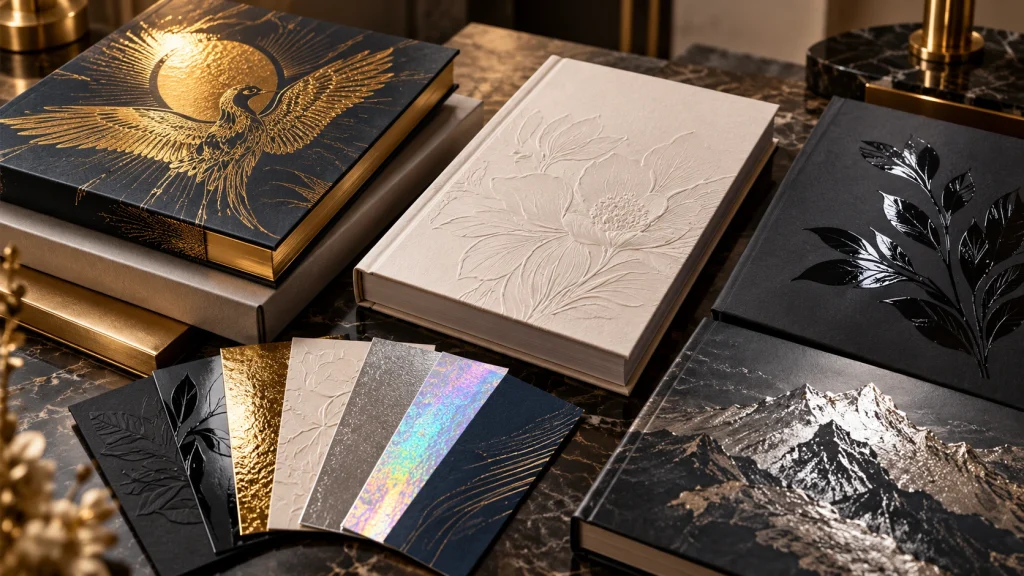
Book cover finishes are the foils, coatings, textures, and treatments added to a cover after it’s printed. The right choice depends on four things: your book’s genre, how readers will handle it, which design element you want to stand out, and your budget. Foil stamping and embossing work best on titles, author names, and logos. Spot UV adds shine to selected areas of a matte cover. Soft-touch lamination gives a velvety, upscale feel. Gloss lamination protects books that get heavy use.
You’ve finished the manuscript, the cover art looks great on screen, and now your printer is asking: gloss or matte? Foil? Spot UV? Embossing? Many authors guess. Others skip finishes to save money and end up with a cover that looks flat next to traditionally published titles. Some add every effect available and get a cover that feels cluttered.
In our 30+ years of combined experience at PRC Book Printing, we’ve helped thousands of authors and publishers nationwide choose finishes that fit the book. This guide explains what each premium finish does, why finish decisions go wrong, and how to pick the right combination for your project.
What You’ll Learn
- What Goes Wrong When Book Cover Finishes Are Chosen Without a Plan?
- The Real Causes Behind Book Cover Finish Mistakes
- A Quick Guide to Premium Book Cover Finishes
- How to Choose the Right Finish for Your Book
- Solution Options: Proven Finish Combinations by Book Type
- Why Authors Nationwide Choose PRC Book Printing
- Frequently Asked Questions
- Next Steps
What Goes Wrong When Book Cover Finishes Are Chosen Without a Plan?
A finish problem usually isn’t obvious until the books arrive. The cover printed correctly, but something about it feels off in your hands.
Common signs include:
- The cover looks flat or “self-published” next to similar titles on a bookstore shelf
- Foil text looks blotchy, broken, or hard to read
- Spot UV areas don’t line up with the artwork underneath
- A soft-touch cover shows fingerprints, scuffs, or stains after a few weeks of use
- Embossed letters look soft instead of crisp
- The cover has so many effects that nothing stands out
- The finishes added cost, but the book still doesn’t look premium
This happens most often to authors moving from print-on-demand to offset printing for the first time. Most POD platforms only offer gloss or matte covers, so foil, embossing, and spot UV are new decisions.
It matters because your cover is your first sales tool. Readers and bookstore buyers judge quality in seconds. And with an offset print run of 500 or more copies, a finish mistake is repeated on every single book.
The Real Causes Behind Book Cover Finish Mistakes
After reviewing thousands of cover files in our pre-press department, we see the same four causes again and again.
Cause #1: Finishes Are Chosen on a Screen, Not in Hand
Foil, spot UV, and embossing are physical effects. They catch light, add texture, and change how a cover feels. A flat mockup on a monitor can’t show any of that.
Authors often approve a design that looks balanced on screen, then find the foil overpowers the cover or the spot UV is too subtle to notice. If you’ve never seen a finish in person, ask your printer for printed examples before you commit.
Cause #2: The Finish Doesn’t Match How the Book Will Be Used
Every finish has a job. Soft-touch lamination feels luxurious, but it shows scuffs and stains more easily. That’s a problem for a cookbook sitting next to the stove. Gloss lamination resists spills and wipes clean, but it can look less refined on a literary novel.
Children’s books handled by small hands need durable lamination more than delicate effects. When the finish doesn’t match real-world handling, it wears out fast or works against the design.
Cause #3: The Artwork Isn’t Built for the Finish
This is the most common cause we catch in pre-press. Foil, spot UV, and embossing each need a separate file layer, often called a mask, that shows exactly where the effect goes.
When that layer is missing, misaligned, or built with hairline strokes and tiny text, the results suffer. Foil breaks up. Spot UV sits slightly off the image. Embossing loses its detail. Busy, detailed photos can also hide a spot UV effect completely.
Cause #4: Too Many Effects and No Clear Focal Point
Premium finishes work through contrast. A single foil title on a matte cover draws the eye because nothing competes with it. Stack foil, spot UV, embossing, and a textured coating on one cover, and the effects cancel each other out. You pay for every finish, but none of them gets noticed.
A Quick Guide to Premium Book Cover Finishes
Here’s what each finish does and where it works best.
| Finish | What It Does | Best For | Keep in Mind |
|---|---|---|---|
| Foil Stamping | Applies metallic or colored foil (gold, silver, copper, holographic) using heat and pressure | Titles, author names, logos, series branding, hardcover spines | Avoid hairline strokes and small text; bold type works best |
| Embossing / Debossing | Raises (emboss) or presses in (deboss) part of the cover | Titles, monograms, logos, cloth and leatherette hardcovers | Very fine detail can soften; pairs well with foil |
| Spot UV | Adds a clear, glossy coating to selected areas | Making a title, image, or pattern shine against a matte background | Needs a matte or soft-touch base for contrast |
| Soft-Touch Lamination | Gives the cover a velvety, low-shine feel | Literary fiction, memoir, business books, gift books | Shows scuffs and stains more than other laminates |
| Gloss Lamination | Adds a shiny protective film | Children’s books, cookbooks, photo-heavy covers | Can create glare under bright light |
| Matte Lamination | Adds a smooth, low-shine protective film | Novels, non-fiction, a base for spot UV | Can slightly mute very bright colors |
| Die-Cutting | Cuts custom shapes or windows into the cover | Children’s books, board books, special editions | The page under a cut window needs planning |
| Scodix Enhancements | Adds raised, textured, or metallic digital effects | Special editions and designs that need fine texture | Review a printed sample first |
| Cloth and Leatherette Covers | Wraps the hardcover case in textured material | Gift editions, anniversary editions, coffee table books | Usually paired with foil stamping or debossing |
| Dust Jackets | Adds a printed, removable wrap to a hardcover | Bookstore hardcovers, collector editions | Gives you a second surface for finishes |
How to Choose the Right Finish for Your Book
Work through these questions in order. Most authors land on a clear answer by step four.
- What do books in your genre use? Pull 5 to 10 bestsellers from your category and look closely at the covers. Thrillers often use foil or spot UV on bold titles. Literary fiction leans toward soft-touch and subtle debossing. Children’s books favor gloss for durability.
- How will readers handle the book? A cookbook needs a cover that wipes clean. A coffee table book needs to look good from across the room. A picture book needs to survive sticky fingers.
- What one element should stand out? It’s usually the title or author name. Put your premium finish there and keep the rest of the cover clean.
- Is your artwork built for it? Check that foil and embossed type is bold enough, and confirm your designer can supply separate finish layers.
- Hardcover or softcover? Hardcovers open the door to cloth, leatherette, dust jackets, and foil-stamped spines. Softcovers rely more on lamination, spot UV, and foil on the front cover.
- What fits your budget and quantity? Each finish adds cost per copy, but that cost spreads out as your print run grows.
You can handle steps one through three on your own. Bring your printer in before the cover design is final, not after. Changing a foil layer during pre-press is easy. Changing it after books are printed isn’t possible.
Solution Options: Proven Finish Combinations by Book Type
What You Can Do Before Contacting a Printer
- Collect comparison titles and photograph their covers in natural light
- Pick one “hero” element for your premium finish
- Ask your designer to build each finish on its own layer as clean vector art in a solid color
- Keep foil and spot UV away from very fine detail and off the spine fold on softcovers, where it can crack
- Don’t approve a finish you’ve only seen on a screen
Premium Book Cover Finishes That Work Well Together
- Novels and memoirs: Soft-touch lamination with foil or spot UV on the title
- Thrillers and genre fiction: Matte lamination with spot UV or metallic foil on a bold title, sometimes embossed
- Children’s picture books: Gloss or matte lamination for durability, with spot UV on a character or title kids can touch
- Board books: Durable lamination with rounded corners and optional die-cut shapes, printed with safety-compliant soy-based inks and aqueous coatings
- Cookbooks: Gloss or matte lamination that wipes clean, with a foil title (skip soft-touch)
- Coffee table and art books: A cloth case with a foil-stamped spine, plus a dust jacket with soft-touch and spot UV
- Business and corporate books: Soft-touch lamination with a foil or debossed logo, or leatherette for executive gift editions
Why Professional Offset Printing Makes Sense
Most print-on-demand services can’t produce foil, embossing, spot UV, or Scodix effects at all. Offset printing gives you the full range.
At PRC Book Printing, our pre-press team reviews every finish layer before production. We check line weights, alignment, and placement, then explain any issues in plain language. Your digital proof shows exactly where each finish will be applied. Every finished book is inspected before it ships.
Hardcover projects start at 500 to 1,000 copies, and softcover projects start at 1,000 to 2,000 copies. Domestic turnaround is 2 to 5 weeks for softcover and 4 to 6 weeks for hardcover after proof approval. Offshore production runs 9 to 13 weeks. Your finishes are part of your all-inclusive quote, so there are no surprise setup charges.
Why Authors Nationwide Choose PRC Book Printing
PRC Book Printing brings 30+ years of combined industry experience to every project, built on a manufacturing legacy dating to the 1960s. We were established in 2012 in Hatboro, Pennsylvania, and we serve as a regional sales office for one of the largest offset book manufacturers in the United States.
Authors and publishers choose us for:
- Heidelberg offset presses with 4 to 6 color printing for accurate, consistent color
- A full finishing menu including foil stamping, embossing, debossing, die-cutting, spot UV, Scodix, soft-touch lamination, cloth, leatherette, and dust jackets
- Domestic and offshore options so you can balance budget and timeline
- Personal guidance from owner Jacob Hope and Sales & Production Manager Heather Kustra
- All-inclusive pricing with free shipping to the continental US
Frequently Asked Questions
What are the most common book cover finishes?
The most common book cover finishes are gloss lamination, matte lamination, and soft-touch lamination, which protect the cover and set its overall feel. Premium finishes are added on top of those. The most popular are foil stamping, spot UV, and embossing or debossing. Hardcovers can also use cloth or leatherette cases and printed dust jackets.
Is foil stamping worth the extra cost?
Foil stamping is worth it when you use it on one strong focal point, like your title or author name. It catches light on a shelf and signals quality in a way flat ink can’t. It’s less effective when spread across a whole cover or used on thin, detailed type. Used with restraint, it’s one of the best values among premium finishes.
What’s the difference between spot UV and gloss lamination?
Gloss lamination covers the entire cover with a shiny protective film. Spot UV is a clear, glossy coating applied only to selected areas, like a title or image. Spot UV works best on top of a matte or soft-touch cover, where the contrast between shiny and flat areas makes the effect stand out.
Can you combine foil stamping and embossing on the same cover?
Yes. Foil stamping and embossing are often combined on the same element, which gives you raised, metallic lettering. This works especially well for titles on hardcover cases and dust jackets. The key is lining up the foil and emboss layers exactly in your files. Our pre-press team checks that alignment before your book goes to press.
Which book cover finish is best for a cookbook?
Gloss or matte lamination is usually the best finish for a cookbook because both wipe clean and resist spills. Soft-touch lamination looks beautiful but shows stains and scuffs more easily in a kitchen. A foil-stamped title adds a premium touch without affecting durability. Pair your cover with lay-flat binding so the book stays open while you cook.
How much do premium book cover finishes cost with PRC Book Printing?
The cost of premium book cover finishes depends on the finish, the size of the area covered, your book’s format, and your print quantity. Per-copy costs drop as quantities increase. PRC Book Printing includes finishes in your all-inclusive quote with no hidden fees. Call (888) 659-8320 for a free, no-obligation quote, typically within 24 hours.
Do premium finishes add time to book printing?
Some finishes add production steps, and we build that into the timeline we give you at quote. Domestic printing typically takes 2 to 5 weeks for softcover and 4 to 6 weeks for hardcover after proof approval. Offshore printing takes 9 to 13 weeks. Planning your finishes early helps keep your launch date on track.
How do I prepare my files for foil stamping or spot UV?
Your designer should create a separate layer or file for each finish, built as clean vector art in a solid color. That layer shows exactly where the foil or spot UV goes. Avoid hairline strokes and very small text. PRC Book Printing’s pre-press team reviews every finish file and explains any needed changes before production.
Next Steps
Key takeaways:
- Choose finishes based on genre, handling, and one clear focal point
- Spot UV needs a matte or soft-touch base to stand out
- Build every finish on its own file layer, with bold lines and type
- Involve your printer before your cover design is final
If you’re planning a book and want premium book cover finishes that fit your project, PRC Book Printing can help you choose. Call (888) 659-8320 or email info@prcbookprinting.com for a free, no-obligation quote. We typically respond within 24 hours, Monday through Friday, 9 AM to 5 PM EST, and we serve authors nationwide with free shipping to the continental US.
This article was written by the PRC Book Printing expert team, professional book manufacturers with over 30 years of combined experience in the printing and publishing industry. Based in Hatboro, Pennsylvania, our team operates industry-leading Heidelberg offset presses and has helped thousands of authors, publishers, and businesses nationwide create exceptional printed books, from hardcover novels to children’s board books, cookbooks to coffee table books.
Have questions about your book printing project? Call (888) 659-8320 or email info@prcbookprinting.com for a free, no-obligation quote.