You’ve spent months—maybe years—writing, editing, and designing your book. Now the printer sends you a proof and asks for your approval before the presses run. It feels like a formality, so you skim it, sign off, and wait for your boxes to arrive. Then they show up: the spine text is crooked, the interior margins swallow a line of text into the gutter, and page 47 is somehow blank. Sound familiar? A rushed proof approval is one of the most expensive mistakes a self-publishing author can make, because once you sign off, those errors are printed across your entire run. In our 30+ years of combined experience serving authors and publishers nationwide, PRC Book Printing has seen how a careful book proof checklist turns proof approval from a nerve-wracking gamble into a confident final step. This guide walks you through exactly what to verify before your book goes to press.
What You’ll Learn
- What Is a Book Proof and Why Does Approval Matter?
- The Real Causes Behind Proof Approval Mistakes
- How to Identify Problems in Your Proof
- The 15-Point Book Proof Approval Checklist
- Why Authors Nationwide Choose PRC Book Printing
- Frequently Asked Questions
- Next Steps
What Is a Book Proof and Why Does Approval Matter?
A book proof is a representation of your finished book—either a digital file or a physical sample—that shows exactly how your title will look once printed. It’s your last chance to catch problems before production begins. When you approve a proof, you’re telling the printer that everything is correct and giving them permission to print your entire order.
Here’s why that moment carries so much weight:
- It’s the point of no return. Errors caught before approval cost nothing to fix; errors caught after are printed on every copy.
- It reflects the final product—not your design file. A proof accounts for how ink sits on paper, how color shifts during printing, and how binding affects margins.
- It protects your reputation. Readers judge quality instantly, and a visible defect can trigger negative reviews.
First-time authors most often experience proof problems because they assume the proof is just a preview rather than a working document meant to be inspected line by line.
The Real Causes Behind Proof Approval Mistakes
Most proof approval disasters aren’t caused by the printer. They happen because of predictable, avoidable issues in how the proof is reviewed. Understanding why these mistakes occur helps you avoid them.
Rushing the Review Under Deadline Pressure
Authors eager to hit a launch date often glance at a proof and approve it within minutes. The problem is that proofreading a printed layout is fundamentally different from proofreading a manuscript. Your eye slides past familiar text because your brain fills in what it expects to see. Signs this is happening to you: you spent less than an hour on the proof, or you only checked the pages you were “worried about.” Rushing almost guarantees something slips through.
Confusing Your Design File with the Printed Result
Many authors assume that if their file looked right on screen, the printed book will match. But screens display color in RGB while presses print in CMYK, and that conversion shifts certain colors—bright blues, oranges, and greens especially. Fonts can also reflow, images can lose resolution, and full-bleed elements can get trimmed differently than expected. What most authors don’t realize is that the proof exists precisely to reveal these differences, which is why it must be reviewed on its own terms.
Reviewing Alone Without a Fresh Set of Eyes
You are the worst possible proofreader of your own book because you already know what it should say. After months of staring at the same pages, you’ve memorized them. A second reviewer catches errors you’re now blind to. Authors who approve solo consistently miss typos, doubled words, and formatting glitches that a fresh reader spots in minutes.
Not Knowing What to Look For
The biggest cause of all is simply not having a system. Without a checklist, authors review whatever catches their eye and skip everything else. Based on our experience with thousands of book projects, the authors who approve confidently are the ones working through a structured list rather than relying on memory or instinct.
How to Identify Problems in Your Proof
Before you dive into the full checklist, run this quick self-assessment to gauge how carefully you need to review:
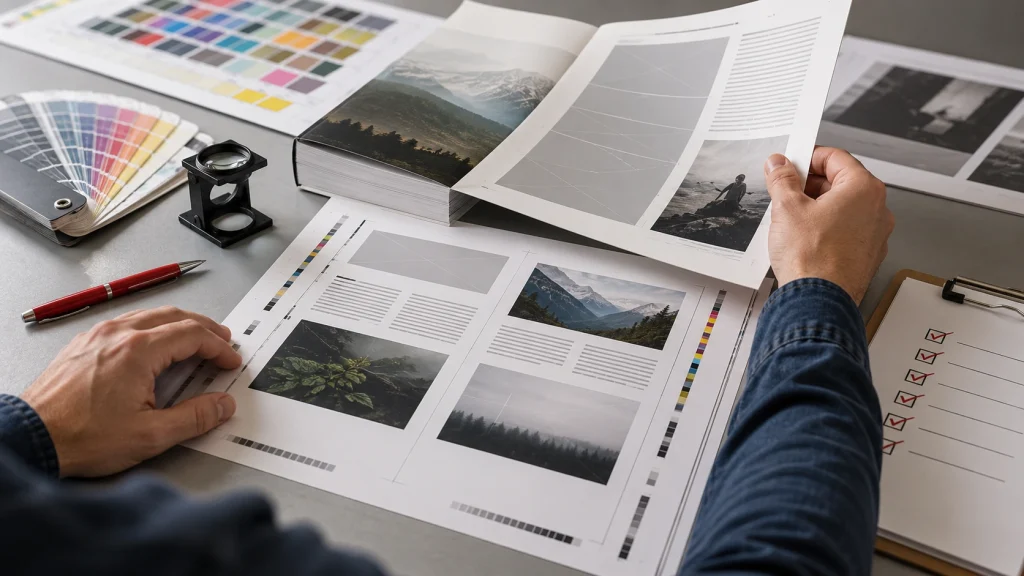
- Print or view the proof at 100% actual size. Viewing a scaled-down PDF hides small errors. If your printer provides a physical proof, inspect that copy directly.
- Compare the proof against your original files side by side. Open your source file and the proof together and scan for anything that shifted.
- Check whether text sits too close to the spine or trim edge. If words disappear into the binding or run off the page, you have a margin problem.
- Look for color that appears duller or different than your screen. This signals an RGB-to-CMYK issue worth flagging.
- Ask a second person to read at least the first and last chapters. If they spot errors quickly, the whole book needs a slower review.
If any of these raise a red flag, don’t approve yet. Work through every item below before signing off.
The 15-Point Book Proof Approval Checklist
Here’s what we tell every author who calls: work through this list in order and don’t skip a single item. This is the same systematic review our pre-press team encourages before any book goes to press.
- Cover text and title spelling. Read every word on the front cover, spine, and back cover out loud. Title and author-name typos are shockingly common and utterly unforgiving.
- Spine text alignment and centering. Confirm the spine text is centered and reads correctly. On thinner books especially, spine text can drift toward one edge.
- Front and back cover color accuracy. Check that cover colors match your expectations, remembering that printed CMYK differs from screen RGB. Flag anything that looks off before approval.
- Barcode and ISBN placement. Verify the barcode scans conceptually correctly and that the ISBN matches your registered number exactly. A wrong ISBN can derail distribution.
- Page count and blank pages. Confirm the total page count matches your file and that no pages are unexpectedly blank or duplicated.
- Page numbering sequence. Scan that page numbers run in order with no skips, repeats, or numbers appearing on pages that shouldn’t have them (like chapter openers).
- Interior margins and gutter space. Make sure no text falls into the gutter—the inner margin where pages meet the binding. This is one of the most frequently missed issues.
- Running headers and footers. Check that chapter titles, author names, or book titles in the headers are correct and consistent throughout.
- Chapter starts and section breaks. Verify chapters begin where they should, on the correct left or right page, with consistent formatting.
- Image resolution and placement. Inspect every image for sharpness and correct positioning. Blurry or pixelated images mean the source file resolution was too low.
- Image and photo color. For full-color books, cookbooks, and children’s titles, confirm that photos and illustrations look vibrant and accurate rather than muddy or shifted.
- Font consistency. Look for any font that unexpectedly changed—a common sign that a typeface didn’t embed properly in your file.
- Widows, orphans, and awkward breaks. Check for single lines stranded at the top or bottom of a page and hyphenation that breaks words awkwardly.
- Table of contents accuracy. Confirm that every entry in your table of contents points to the correct page number.
- Bleed and trim on full-bleed elements. For any images or colors meant to run to the edge of the page, verify they extend fully with no white slivers after trimming.
Once you’ve worked through all fifteen, you can approve with genuine confidence rather than crossed fingers. And if something looks wrong, say so. At PRC Book Printing, our pre-press team reviews every file before production, explains any technical issues in plain language, and welcomes your questions and revision requests at the proof stage. Approval should never feel like a leap of faith.
Why Authors Nationwide Choose PRC Book Printing
PRC Book Printing is a professional offset book printing company based in Hatboro, Pennsylvania, serving authors, publishers, and businesses across all 50 states. Founded in 2012 and rooted in a manufacturing legacy dating to the 1960s, our team brings 30+ years of combined experience to every project.
We print on industry-leading Heidelberg offset presses, delivering the color accuracy and consistency that ensures every copy in your run looks identical—the kind of quality that makes a proof review something you can trust. Our all-inclusive, transparent pricing covers pre-press, proofing, materials, printing, binding, packaging, and free shipping to the continental US, with no hidden fees or setup charges. Owner Jacob Hope and Sales & Production Manager Heather Kustra provide hands-on, personal guidance, so first-time authors never navigate the proof stage alone. With accessible minimums and a rigorous quality inspection before shipping, PRC makes bookstore-quality printing genuinely reachable.
Frequently Asked Questions
What is a book proof approval? Book proof approval is the step where you review a representation of your finished book and formally authorize the printer to run your full order. It’s your final opportunity to catch errors in text, color, layout, or binding before those errors are printed across every copy.
What should I check before printing a book? Before printing, verify cover spelling, spine alignment, color accuracy, ISBN and barcode, page count, page numbering, interior margins, headers, image resolution, font consistency, the table of contents, and full-bleed trim. Working through a structured book printing proof checklist ensures nothing slips through.
How long does it take to review a book proof properly? A thorough proof review typically takes a few hours, not minutes. Rushing is the leading cause of missed errors, so give yourself unhurried time and, ideally, a second reviewer to read the pages with fresh eyes before you approve.
Why do the colors in my proof look different from my screen? Screens display color in RGB while printing presses use CMYK, and that conversion shifts certain colors—especially bright blues, greens, and oranges. This is normal and expected, which is exactly why reviewing a proof rather than trusting your design file matters.
Can I request changes after seeing my proof? Yes. The proof stage exists so you can request corrections before production. At PRC Book Printing, questions and revision requests are welcome at this stage, and our team helps you resolve any issues before your book goes to press.
How much does book printing cost with PRC Book Printing? PRC offers all-inclusive, transparent pricing based on your book’s specifications, quantity, and finishing options, with free shipping to the continental US included. Contact us for a free, no-obligation quote—typically returned within 24 hours.
What is the minimum order quantity for offset book printing? PRC offers accessible offset minimums starting at 500–1,000 copies for hardcover and 1,000–2,000 copies for softcover and board books, making professional-quality printing reachable for independent authors and small publishers.
Do you ship to all 50 states? Yes. PRC Book Printing serves authors nationwide from Hatboro, Pennsylvania, with free shipping to all continental US addresses. Contact us for shipping details to Alaska and Hawaii.
Next Steps
A confident proof approval comes down to a few key habits:
- Review the proof at actual size, never a scaled-down preview
- Work through all 15 checklist items rather than trusting your eye
- Bring in a second reviewer for a fresh perspective
- Speak up about any issue—the proof stage is built for corrections
Ready to print your book with a team that guides you through every step? Contact PRC Book Printing for a free, no-obligation quote. Call (888) 659-8320 or email info@prcbookprinting.com. We respond within 24 hours and serve authors nationwide with free shipping to the continental US. Monday–Friday, 9 AM – 5 PM EST.
This article was written by the PRC Book Printing expert team, professional book manufacturers with over 30 years of combined experience in the printing and publishing industry. Based in Hatboro, Pennsylvania, our team operates industry-leading Heidelberg offset presses and has helped thousands of authors, publishers, and businesses nationwide create exceptional printed books—from hardcover novels to children’s board books, cookbooks to coffee table books.
Have questions about your book printing project? Call (888) 659-8320 or email info@prcbookprinting.com for a free, no-obligation quote.